












Dennis Miracles Aboagye Accuses NDC Government of Dodging Responsibility Despite Economic Gains


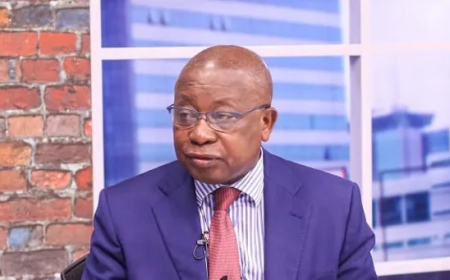
The Director of Communications for the Bawumia Campaign Team, Dennis Miracles Aboagye, has criticised the National Democratic Congress (NDC) government for what he describes as a reluctance to accept responsibility for the everyday hardships faced by Ghanaians, even as macroeconomic indicators show notable improvement.
Speaking on Newsfile on JoyNews on Saturday, February 28, during discussions on the 2026 State of the Nation Address, Mr. Aboagye argued that the true condition of a nation should be measured by the well-being of its citizens rather than headline economic statistics.
“I think the state of the nation is just the aggregation of every person within the state. And so if you have the majority of the elements within the state not doing so well, that is what will tell on the state,” he stated.
He acknowledged that Ghana’s macroeconomic performance over the past year has been strong, noting significant improvements in inflation and currency stability.
“The macroeconomic performance in the last one year is without doubt. There was no debate about that,” he said.
“The fact that we’ve seen unprecedented improvement in inflation, never seen before. I doubt even first-world countries see this kind of macroeconomic improvement in such a short period.”
Mr. Aboagye also pointed to the strengthening of the cedi as a clear positive development. However, he questioned the sustainability of these gains and urged the government to explain what factors are driving the improvements.
“The details as to whether it’s sustainable, based on what is driving it, is another conversation. It’s time for the government to actually sit back and be honest with themselves,” he said.
He called on authorities to provide transparency about the sources of economic stability to prevent future excuses if conditions deteriorate.
“First of all, you need to begin to tell the Ghanaian people what is driving this improvement. So that, should anything go wrong, which we are not praying for, you don’t come back with excuses,” he added.
According to him, Ghana’s recent economic stability is largely linked to high international gold prices, warning that reliance on a single commodity exposes the country to external shocks.
“We’ve always made a point about gold, and we’ve said that if gold is what is driving us, then we are in trouble. Because we don’t control it. One single thing is what has driven us to where we are now high international market price for gold,” he argued.
He cautioned that a drop in gold prices could threaten the country’s current stability.
“Tomorrow, should gold drop to 2,000 dollars, can we survive?” he asked.
Mr. Aboagye also referenced the cocoa sector, suggesting that global market dynamics can quickly reverse economic gains. He cited remarks attributed to a government official about imposing sacrifices on cocoa farmers to prevent sector collapse as evidence of underlying fragility.
While conceding that improved macroeconomic indicators have benefited some Ghanaians, he argued that the impact has been uneven.
“I have said it here that the government’s performance in the last one year has benefited, in my view, some 10 to 15 per cent of the population,” he claimed.
He explained that individuals and businesses that rely on foreign exchange or import goods have gained significantly from currency stability and reduced fuel costs.
“The person who imports directly and needs forex benefited big time. The person who pays anything in dollars benefited. Who drives to the fuel station to buy fuel for their vehicle, plant, or machinery benefited,” he said.
However, he maintained that ordinary commuters and low-income earners have not experienced the same level of relief. He noted that a large majority of residents in Accra depend on commercial transport, where limited vehicle availability continues to push up fares and worsen commuting conditions.
“The person joining the trotro also hasn’t. That is where the issue comes in,” he said.
He cited transport pressures forcing workers to wake up as early as 3:00 a.m. to secure rides to work, only to arrive late and return home exhausted after long days.
Mr. Aboagye stressed that economic management must ultimately improve daily living conditions.
“What is macroeconomy without its positive impact on micro?” he asked. “The whole essence of macroeconomic management is the output on the microeconomy.”
“If you drive your macroeconomic indicators to the best of numbers and your micro is not positively affected, you’ve done nothing,” he concluded.
What's Your Reaction?
 Like
0
Like
0
 Dislike
0
Dislike
0
 Love
0
Love
0
 Funny
0
Funny
0
 Angry
0
Angry
0
 Sad
0
Sad
0
 Wow
0
Wow
0