




















Tariffs Cannot Resolve Growing Global Economic Imbalances - IMF

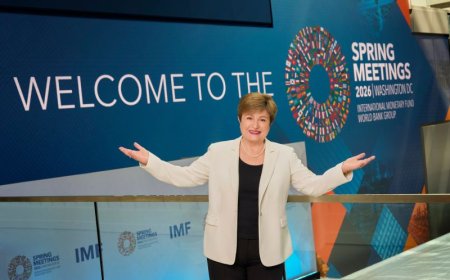
The International Monetary Fund (IMF) has warned that rising global economic imbalances are being driven mainly by domestic macroeconomic conditions, not by trade barriers or targeted industrial strategies. The caution comes at a time when many governments are embracing protectionist policies and economic nationalism.
In early April, the IMF Executive Board endorsed a staff paper that arrives at a sensitive moment for the world economy. Trade frictions are deepening, current account surpluses and deficits remain persistent, and countries are increasingly relying on tariffs and industry-specific support to shield their local firms.
However, the IMF’s analysis argues that these measures miss the core issue. According to the assessment, external imbalances are primarily shaped by the relationship between national saving and investment dynamics influenced by fiscal decisions, domestic demand patterns, and broader macroeconomic frameworks.
The key takeaway from the Fund is straightforward: restricting imports or channelling resources into selected sectors does little to correct the structural forces driving global imbalances.
The report notes that tariffs, often promoted as tools to improve current account balances, rarely result in lasting gains unless implemented temporarily or paired with policies that increase public savings. Likewise, narrow industrial policies tend to have weak or unpredictable outcomes unless they substantially improve productivity and shift national saving and investment behaviour.
This perspective challenges the belief that trade actions alone can fix imbalances. Instead, it places responsibility on domestic economic management rather than external competition.
The IMF maintains that traditional macroeconomic measures including fiscal consolidation, monetary stability, and reforms that influence how households and firms save and invest remain the most reliable ways to address persistent imbalances.
The Fund acknowledges that broad industrial strategies may contribute more visibly, but warns that these approaches often involve significant trade-offs, such as reduced domestic consumption and adverse spillovers for other economies. In some cases, headline improvements in external balances may come at the cost of lower global welfare.
One of the report’s central conclusions is that the world cannot rebalance effectively if only one side adjusts. Scenario analysis indicates that meaningful progress requires coordinated action from both surplus and deficit countries. Without joint efforts, adjustments tend to fall unevenly, increasing the likelihood of financial instability, volatile capital flows, and heightened trade disputes.
The IMF Executive Board supported the analysis, reiterating that entrenched imbalances threaten global macroeconomic and financial stability. Board members also emphasised that trade and industrial policies cannot replace reforms aimed at strengthening productivity and domestic demand resilience.
For emerging and developing economies such as Ghana, the risks are amplified. Although global imbalances are often discussed in the context of major economies, their spillovers including exchange rate swings and tighter international financing conditions disproportionately affect smaller, open markets.
For Ghana, which is navigating a delicate post–debt restructuring phase, disorderly global adjustment could lead to increased borrowing costs, currency pressures, and reduced room for policy manoeuvring.
The IMF is therefore calling for deeper international cooperation and stronger global oversight. This includes improving economic data reporting, enhancing external balance assessment frameworks, and expanding monitoring to cover capital flows and external balance sheets.
This broader approach reflects an important concern: imbalances may appear manageable for long periods but become destabilising when shifts in investor confidence trigger sudden reversals.
In essence, the IMF’s message challenges what it describes as symbolic policy actions tariffs and politically appealing industrial initiatives that fail to address underlying economic fundamentals.
Lasting global adjustment, the Fund argues, will require difficult domestic reforms carried out in parallel across major economies. Without such coordinated action, rising imbalances could remain a continuing source of global economic volatility.
What's Your Reaction?
 Like
0
Like
0
 Dislike
0
Dislike
0
 Love
0
Love
0
 Funny
0
Funny
0
 Angry
0
Angry
0
 Sad
0
Sad
0
 Wow
0
Wow
0