
















Ghana’s Anti-Corruption Drive Shows Little Progress as CPI Score Stalls at 43

Ghana’s fight against corruption has failed to record any meaningful gains, as the country’s score in the 2025 Corruption Perceptions Index (CPI) remains virtually unchanged, raising fresh concerns about the effectiveness of anti-graft efforts.
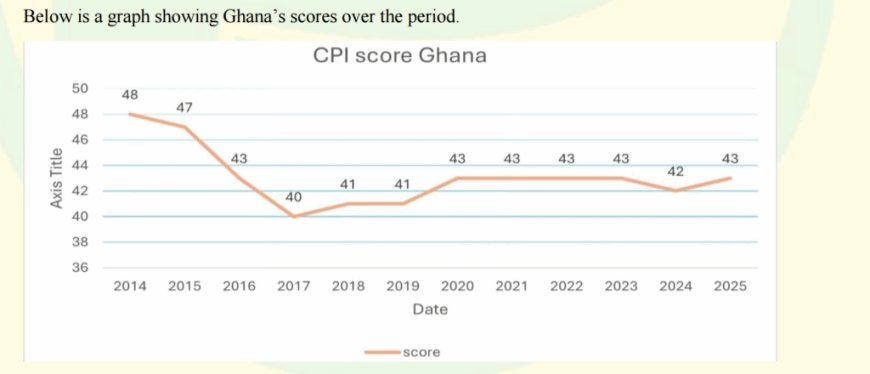
According to Transparency International, Ghana scored 43 out of 100, ranking 76th out of 182 countries assessed globally. Although this represents a marginal one-point increase from the 42 recorded in 2024, experts say the change is statistically insignificant and does not reflect real progress.
The CPI results, released on Tuesday, February 10, 2026, show that Ghana has largely stagnated at a score of 43 since 2020, with the exception of last year’s slight dip. The country’s best performance remains 48 in 2014, after which scores declined steadily until 2018.
Calls for Stronger Cooperation
Chair of Transparency International’s Board, François Valérian, stressed that corruption cannot be tackled through isolated national efforts alone, calling for stronger global cooperation anchored in accountability and transparency.
“In an interconnected world, we need both national action and multilateral cooperation to protect the public interest and address shared challenges like corruption,” he said, warning against the erosion of international norms and democratic accountability.
Domestic Concerns Undermine Confidence
The latest CPI assessment comes against the backdrop of mounting concerns over the politicisation of Ghana’s justice and law enforcement institutions.
Issues such as the removal of a former Chief Justice, petitions targeting heads of independent bodies, and the discontinuation of corruption prosecutions through a controversial 60:40 settlement arrangement have raised fears of executive interference.
Under the settlement policy, some officials accused of corruption were allowed to avoid prosecution by paying a portion of allegedly misappropriated funds—a move that weakened public confidence following the launch of Operation Recover All Loot (ORAL).
Although the Office of the Special Prosecutor (OSP) has taken steps to enhance transparency in investigations and prosecutions, the Ghana Integrity Initiative (GII)—Transparency International’s local chapter—says these actions have yet to translate into tangible results.
Global and Regional Trends
Globally, corruption levels continue to worsen, even in long-established democracies. The number of countries scoring above 80 points has fallen from 12 a decade ago to just five, while the global average now stands at 42.
Sub-Saharan Africa remains the lowest-performing region, with an average score of 32 out of 100. Of the region’s 49 countries, 10 have recorded significant declines since 2012, while only seven have shown notable improvement.
Reform Recommendations
TI-Ghana has urged the government to prioritise justice sector reforms, including the establishment of specialised anti-corruption courts and the swift adoption of the National Ethics and Anti-Corruption Action Plan (NEACAP).
Additional recommendations include:
- Fast-tracking the Community Tribunal Bill
- Reforming political party financing laws
- Safeguarding media freedom and civic space
- Promoting ethical leadership and cultural reorientation
- Improving transparency in regulatory agencies
- Strengthening anti-money laundering awareness among non-financial businesses
TI-Ghana emphasised that the CPI is intended as a warning signal rather than a final judgement, noting that defensive reactions will not improve public perception.
“With sustained political will and measurable reforms, Ghana can rebuild public trust and achieve stronger anti-corruption outcomes over time,” the organisation stated.
What's Your Reaction?
 Like
0
Like
0
 Dislike
0
Dislike
0
 Love
0
Love
0
 Funny
0
Funny
0
 Angry
0
Angry
0
 Sad
0
Sad
0
 Wow
0
Wow
0